Wednesday, November 01, 2006
Less may be More?
Just checked the Morning Star web site, over 90% of mutual funds being listed there got positive return this year, the top 10% got better than 25% return in a year. All sectors went up except the disappointing Japan sector. Once the S&P reached a new high 1326.57 on Sep 26, the lagging sectors began to catch up. It looks like fund managers who had sat out the first phase of the bull run scrambled to invest in stocks and sectors that trailed behind, in an effort to keep up. We are in the big bull cycle again. But, once market participants gain conviction that the trend is changing, they reduce their hedging, and items they hedged for falls of record. That's what happened earlier this year in the commodities. And it's likely to happen again.
 The theory about market cycles, in the eye of physicists, is a classical pendulum model. That's obviously too primitive. No process can go on for infinite time, some irregularity must occur to propagate its mismatch faintly throughout the entire system. Economic and political structure is built by local forces. They cannot achieve perfection. When once they fail the effect must be made up somewhere. Soros sure know about this. He called this "reflexivity" in his book.
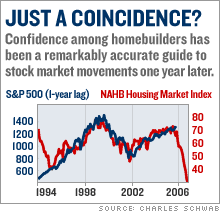
Financial dynamics is governed by phenomena analogous to criticality in the statistical physics sense. The scaling acquires a correction that is periodic in the logarithm of the distance from the critical time (i.e. the day of the crash). The figure shown in Fortune looks horrible. It worth further exploration.
The theory about market cycles, in the eye of physicists, is a classical pendulum model. That's obviously too primitive. No process can go on for infinite time, some irregularity must occur to propagate its mismatch faintly throughout the entire system. Economic and political structure is built by local forces. They cannot achieve perfection. When once they fail the effect must be made up somewhere. Soros sure know about this. He called this "reflexivity" in his book.Financial dynamics is governed by phenomena analogous to criticality in the statistical physics sense. The scaling acquires a correction that is periodic in the logarithm of the distance from the critical time (i.e. the day of the crash). The figure shown in Fortune looks horrible. It worth further exploration.
# posted by Lobo @ 3:26 AM 

