Wednesday, November 29, 2006
Swiss Privilege
Before I call Swiss Privilege to redeem my investment, my account manager have no idea how bad she is serving me. Swiss Privilege is well known of her good services. They are good at organising golf days and other fun events. But, the company have not much experience towards serious investors. They have no practice of sending annual report of funds to clients. Even on request, they can hardly get you complete. And, you have to repeat this request every year. Last time I suffered from a 'design fault' in their computer system, the problem still exists 7 months after. That's the level of service I am experiencing.
After deducting all charges, the investment in CS have about 15% return per year. It's not too bad when just looking at the figures, but it's the lowest return among my investment. I don't blame her for poor return, but for bad advice and non-professional execute of my instruction. I wrote about the incident in my blog in May. I am serious about my investment, of course, as that's my major source of income.
I am still looking for more efficient investment platform, better analysis tools and more professional services.
After deducting all charges, the investment in CS have about 15% return per year. It's not too bad when just looking at the figures, but it's the lowest return among my investment. I don't blame her for poor return, but for bad advice and non-professional execute of my instruction. I wrote about the incident in my blog in May. I am serious about my investment, of course, as that's my major source of income.
I am still looking for more efficient investment platform, better analysis tools and more professional services.

Tuesday, November 28, 2006
Be happy when market slump
Today, global markets all go down.
I bought some put options on HSI and Bank of China early this morning. Therer is already a 20% to 70% increase in value. The gearing is about 10-20 times. So, about half of the lost today in my long term portfolio should be offset by the gain. The situation can be even better if the market further go down another 5%.
I am still bullish for the long term. Selling short is just a way to handle my emotion. By marking profit on the down side, I would feel better. And I would be more patient while waiting for buying oppuntinities. This help me to stay emotionally neutral and increase the chance for making correct decision later on.
I bought some put options on HSI and Bank of China early this morning. Therer is already a 20% to 70% increase in value. The gearing is about 10-20 times. So, about half of the lost today in my long term portfolio should be offset by the gain. The situation can be even better if the market further go down another 5%.
I am still bullish for the long term. Selling short is just a way to handle my emotion. By marking profit on the down side, I would feel better. And I would be more patient while waiting for buying oppuntinities. This help me to stay emotionally neutral and increase the chance for making correct decision later on.
Monday, November 27, 2006
re-balance
I switched half of my emerging market fund to european fund. Now my fund allocation is roughly as follow:
30% Global Emerging Markets
20% Asia incl China
5% Japan
25% Europe
10% Gold
10% New Energy + Technology
My investment theme is still about globalisation with lower production cost, lower energy effeciency etc.
30% Global Emerging Markets
20% Asia incl China
5% Japan
25% Europe
10% Gold
10% New Energy + Technology
My investment theme is still about globalisation with lower production cost, lower energy effeciency etc.
Thursday, November 23, 2006
Today I fired my financial advisor
At last, I fired my financial advisor and end my investment in Credit Suisse.
This morning, I called my financial advisor. My portfolio in Credit Suisse is of the lowest net return among my investment. At first, I want to discuss about how to reduce my investment risk on this all time highs market. I was expecting her regret on the fault and poor advice she gave me 6 months ago. But I didn't hear anything. As my advisor, she even can't tell what I am holding.... So, my decision is simple.
After I liquidate this investment, I would remain 55% invested.
Next, I have to watch closely the corelation matrix between markets. The economic reason for markets' interrelation flows from the wide substitutability and complementing of goods to consumers and producers. But, even I devoted a lot of time to finding out connections among markets, I don't have adequate tools or knowledge to study them properly.
This morning, I called my financial advisor. My portfolio in Credit Suisse is of the lowest net return among my investment. At first, I want to discuss about how to reduce my investment risk on this all time highs market. I was expecting her regret on the fault and poor advice she gave me 6 months ago. But I didn't hear anything. As my advisor, she even can't tell what I am holding.... So, my decision is simple.
After I liquidate this investment, I would remain 55% invested.
Next, I have to watch closely the corelation matrix between markets. The economic reason for markets' interrelation flows from the wide substitutability and complementing of goods to consumers and producers. But, even I devoted a lot of time to finding out connections among markets, I don't have adequate tools or knowledge to study them properly.
Wednesday, November 22, 2006
For Speculation Mastery
I read the following from Niederhoffer's book 'The Education of a Speculator'. He wrote down the following when he compared the education of a speculator and a musician.
- Study the market every day.
- Start with the stock market first.
- One position is enough.
- Don't boast or tell friends how great your system is.
- Keep a record of all your losing trades. Were you in over your head?
- Paper trade before you start. Save up adequate capital.
- Get to work before the markets open.
- How would Soros have traded that one lot?
- Take a break when you are losing.
- Stay away from badlinage with those former models who cover you.
- Forget about the great prices you could have traded at. Should you enter, add, or exit right now?
- Study the market every day.
- Start with the stock market first.
- One position is enough.
- Don't boast or tell friends how great your system is.
- Keep a record of all your losing trades. Were you in over your head?
- Paper trade before you start. Save up adequate capital.
- Get to work before the markets open.
- How would Soros have traded that one lot?
- Take a break when you are losing.
- Stay away from badlinage with those former models who cover you.
- Forget about the great prices you could have traded at. Should you enter, add, or exit right now?
Wednesday, November 15, 2006
Reduce Stock Market Exposure
The Yield curve inversion happen in Jan-Mar 2006 and Jun-Nov 2006. Of the past 50 years, there were only 10 inversion including this time. 7 of them turned out to be recession within 2 years. This indicates that we are near a major peak.
I am planning a retreat, reduce my exposure to less than 50% and enjoy the low exposure until Apr 07. (Oct and Apr are most dangerous periods as that's accounting period for funds, they may sell poor performing items and post lost to their book to cut the tax)
I am planning a retreat, reduce my exposure to less than 50% and enjoy the low exposure until Apr 07. (Oct and Apr are most dangerous periods as that's accounting period for funds, they may sell poor performing items and post lost to their book to cut the tax)
Tuesday, November 14, 2006
Volatility Smile
Volatility smile is the pattern of implied volatilities found in the market which forms a "smile" shape. This had been known long ago but theoriest still don't have satisfactory quantitative models. Volatility skew in equitiy market could reflect investors' fear of market crashes.
When corp investors are hedging with the Black-Scholes option pricing formula which assumes constant volatility, the smile implies people are hedging their risk based on a wrong assumption. When the market jump, investors who hedged wrongly have to rectify their error.
The Yield Curve is now inverted. The short term borrowing rate is now higher than the long term rate. In the last peak at year 2000, we also have an inverted yield curve.
Now, I am expecting a correction. In order to get a touch of the market, I buy some put option this morning.
When corp investors are hedging with the Black-Scholes option pricing formula which assumes constant volatility, the smile implies people are hedging their risk based on a wrong assumption. When the market jump, investors who hedged wrongly have to rectify their error.
The Yield Curve is now inverted. The short term borrowing rate is now higher than the long term rate. In the last peak at year 2000, we also have an inverted yield curve.
Now, I am expecting a correction. In order to get a touch of the market, I buy some put option this morning.
Thursday, November 09, 2006
Housing Bubble
 If I regard the flat I own as a kind of investment, I am already overloaded in the property sector. I am looking for a portfolio with very steady growth. When the real estate prices go down, I want my investment as my protection. For this reason, I have not included any funds from housing sector in my portfolio. I think I will not include housing funds before the sum of my investment double the value of my home.
Tthe housing bubble may have already reached it's peak. In general, the real estate markets react to business fluctuations with considerable delays. For example, in the case of Japan in the 90s, the downturn in the real estate market occurred about 15 months after the stock market crash. By this reasoning, even the market crash, there should be enough time to liquidate a real estate fund.
Monday, November 06, 2006
What's the difference?

That's my investment in 3 different portfolio from June to Oct. What a difference!
My portfolio in HS is a combination of mutual funds, local stocks and options which are actively traded. The gain mainly come from my option trading in around June and July.
The portfolio in Citi is a combination of medium risk mutual funds with buy and hold stragety. I would reblance it about once every year.
The portfolio in Sussie is a combination of high risk/return funds. As it offers free switching, so I do switching nearly every quarter. I am expecting better return from CS, yet, clearly it's under performing. Besides the fund choices and admin fee, money seems to leak away between every switching.
Exit Strategy
The energy and precious metals markets bull market has been running strong for five years straight. With many markets near record highs, it is difficult to determine which ones offer the best risk/reward. The current housing bubble is a global phenomena, it's deflatation cannot be local. The decline in US housing market would spread out sooner or later. The current liquidity-driven excesses in financial markets and cross-countries imbalances in the global economy is something that never appeared in the history before. Any monetary tightening that goes too far risks a collapse.
I think I must create a plan for exit. The objective would be -- how to stay in the market as long as possible and create a plan for a systematic exit when needed.
I think I must create a plan for exit. The objective would be -- how to stay in the market as long as possible and create a plan for a systematic exit when needed.
Thursday, November 02, 2006
Econophysics
I have just browsed the Amazon website and found that the research area I came across in UST years ago is now called Econophysics. Statistical concepts allow an alternative way to understand the global financial market. There should be a lot of new ideas since I left. I should try to see if I can get some books in local book store next week.
Wednesday, November 01, 2006
Less may be More?
Just checked the Morning Star web site, over 90% of mutual funds being listed there got positive return this year, the top 10% got better than 25% return in a year. All sectors went up except the disappointing Japan sector. Once the S&P reached a new high 1326.57 on Sep 26, the lagging sectors began to catch up. It looks like fund managers who had sat out the first phase of the bull run scrambled to invest in stocks and sectors that trailed behind, in an effort to keep up. We are in the big bull cycle again. But, once market participants gain conviction that the trend is changing, they reduce their hedging, and items they hedged for falls of record. That's what happened earlier this year in the commodities. And it's likely to happen again.
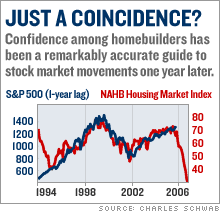 The theory about market cycles, in the eye of physicists, is a classical pendulum model. That's obviously too primitive. No process can go on for infinite time, some irregularity must occur to propagate its mismatch faintly throughout the entire system. Economic and political structure is built by local forces. They cannot achieve perfection. When once they fail the effect must be made up somewhere. Soros sure know about this. He called this "reflexivity" in his book.
Financial dynamics is governed by phenomena analogous to criticality in the statistical physics sense. The scaling acquires a correction that is periodic in the logarithm of the distance from the critical time (i.e. the day of the crash). The figure shown in Fortune looks horrible. It worth further exploration.
The theory about market cycles, in the eye of physicists, is a classical pendulum model. That's obviously too primitive. No process can go on for infinite time, some irregularity must occur to propagate its mismatch faintly throughout the entire system. Economic and political structure is built by local forces. They cannot achieve perfection. When once they fail the effect must be made up somewhere. Soros sure know about this. He called this "reflexivity" in his book.Financial dynamics is governed by phenomena analogous to criticality in the statistical physics sense. The scaling acquires a correction that is periodic in the logarithm of the distance from the critical time (i.e. the day of the crash). The figure shown in Fortune looks horrible. It worth further exploration.


